


Preparing for the unexpected: why emergency management matters

by Portia Yip, Marketing Services
Most of us don't grow up dreaming about a career in emergency management, but sometimes the best careers find us along the way.
After graduating from the University of Victoria (UVic) with a humanities degree, Erin Stockill's career went in different directions. At the time, Erin says she wasn't sure what career to pursue. "I had all these big ideas, and I thought maybe I'll go into policing or I'll be a teacher."
Emergency management was a new field for Erin, and it was rare to hear someone say, "I want to grow up and be an emergency manager." With Erin's early experiences in local government—in areas like recreational programming, event planning, and public safety—she discovered her passion for community-focused work.
"When I was introduced to emergency management, I immediately knew this was a profession that would allow me to bring all my skills together," she says.
Today, Erin has over a decade of experience in emergency management and is currently an emergency program officer with the District of Saanich. She also teaches in the Emergency Management for Organizational Continuity (EMOC) micro-certificate program with Continuing Studies at UVic.

The material is current, relevant, and worth exploring regardless of what you do, your background, or your career goals.
—Erin Stockill, instructor
What is emergency management?
Emergency management is about the behind-the-scenes work that helps communities and organizations prevent, prepare for, and respond to disruptions.
The EMOC program covers many topics such as business continuity, emergency planning, operational resilience, and communication plans. The program is designed to be accessible for professionals working full-time and attracts learners from many industries.
"There's such a diverse group of students and it's quite a growing and dynamic field," Erin shares. "The material is current, relevant, and worth exploring regardless of what you do, your background, or your career goals."
Erin teaches the operational resilience course where learners identify risks and vulnerabilities within their own workplaces. Emergency management appeals to anyone and as Erin emphasizes, you don't need to be an emergency manager to understand, or apply, operational resilience.
"Whether you're creating a business continuity plan or a resilient, emergency plan, there's no one-size-fits-all approach," she says. "There are frameworks, templates and standards that can help, but every organization needs a plan that reflects its own needs."
Creating emergency management plans that work
A strong emergency plan doesn't sit on a shelf forever—it's a living document. Erin recommends sticking to best practices once a plan is in place.
For example, training staff, reviewing plans regularly, and updating documents with new legislations or after an emergency event. Learning from past lessons and experiences is key for continuous improvement.
"These plans should be useable, and everyone should know which version is the most current," she describes. "If your organization has a leadership team, make sure they're briefed and aware of the plan, so you have the support and buy-in needed to keep plans active."
With situations like the wildfires in BC, flooding across the country, or prolonged power outages, these events highlight the importance of emergency preparedness and why professionals may want to build more confidence and new skills in this area.
"I think a big reason we're seeing learners sign up for this program is because of their recent experiences with disruption," says Erin.
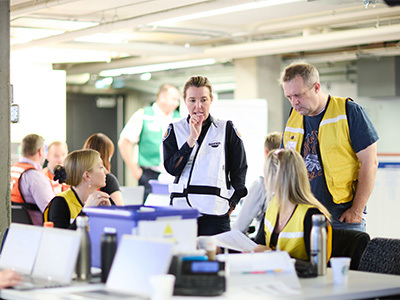
Why professionals are investing in resilience now
New technology also continues to change the emergency management space. Online tools for risk assessments, public alerting apps, drone technology, and risk mapping using Geographic Information Systems (GIS) are now widely used.
"The way we work is faster than ever," Erin says. "So when we're conducting risk assessments, we want to make sure they're data-informed and data-driven."
For example, cyber-attacks are becoming more frequent for organizations and pose a significant risk. The good news is that in the second quarter of 2025, roughly one in five Canadian businesses and organizations (19.8%) plan to increase their cybersecurity measures over the next 12 months.
Artificial intelligence is another factor to consider that will likely affect the field of emergency management, but Erin shares how she doesn't think it's coming for her job yet. "I think there are a lot of unknowns with AI, and it could potentially be a very good tool, but we're just not there yet."
Continuous education and a commitment to lifelong learning
The way we work is faster than ever, so when we're conducting risk assessments, we want to make sure they're data-informed and data-driven.
—Erin Stockill, instructor
Erin encourages future students to be curious and lean into the commitment of lifelong learning. She hopes learners complete the program feeling supported and empowered to apply their knowledge to their own roles.
“You don't have to be an emergency manager to have emergency management skills in your portfolio,” she shares. “I've been very fortunate to have a unique path, not the most linear path, but a path that's led me to what I think is the best job in the world.”
About the instructor

As a proud University of Victoria alumna, Erin Stockill applies her Bachelor of Art (humanities) degree daily in her role as emergency program officer with the District of Saanich. With over 12 years of experience in local government, her diverse background includes recreation programming, event planning, and public safety. Erin has supported several operational resilience and business continuity initiatives including maintaining and updating corporate risk assessments and emergency response plans, and supporting the District of Saanich’s response to the COVID-19 pandemic.
Her passion for operational resilience and emergency management extends beyond her professional role as she actively participates on a number of boards including the BC Association of Emergency Managers and the BC Earthquake Alliance. Erin is also an instructor with the Justice Institute of BC, where she completed her Certificate in Emergency Management and Fire Officer II Certification.
Learn more about Operational Resilience and the Emergency Management for Organizational Continuity (EMOC) micro-certificate.
- Posted July 15, 2026
RELATED TOPICS: Health, Safety and Emergency Management